
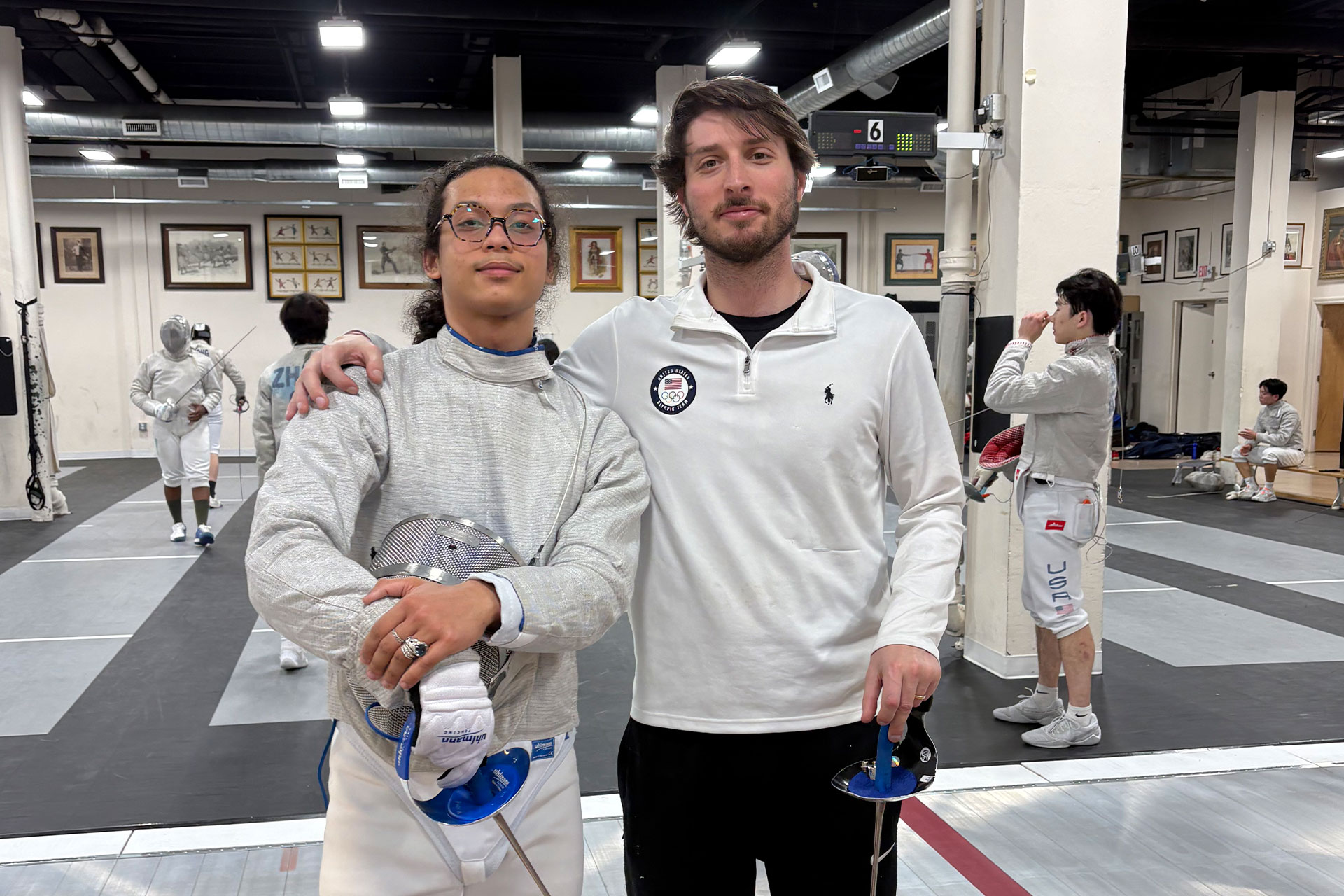
At a glance: On 2 November 2025, Phoenix dislocated his knee one touch from his first rating (E25) and retired from the bout. Cleared to train in a brace, he attended Zeta’s Elite Winter Saber Camp (26 to 30 December 2025) with Olympians Eli Dershwitz and Mitchell Saron, while also playing Bottom in his school’s A Midsummer Night’s Dream.
Training with Olympian Eli Dershwitz at Zeta Fencing
On November 2, 2025, at the EFC’s A Nightmare on Elm Street 2025 tournament, I was on the brink of something I had worked toward for a year. The score was 14–11. I had a clear shot to a touch at the toughest opponent in the tournament. One clean action and I could secure an E25 rating, my first real milestone in competitive fencing.
Then my knee popped.
I went down hard on my left knee, the world suddenly narrowing to pain, confusion, and the strange quiet that comes when you know something has gone wrong. My opponent stood frozen on the strip, disbelief written across his face. When I told the referee I was retiring from the bout, he looked at me like I had spoken another language. He could not believe it, and honestly, neither could I.
Sportsmanship Under Pressure
I wished my opponent well as I limped off the strip. He ended up with the title. He was a really nice kid who had been working hard at fencing for years, grinding through practices, tournaments, and setbacks. I actually felt badly. I had only been fencing for about a year, blessed with natural talent, and I was about to snuff out his dreams for that E25 rating. It did not feel like the kind of win I wanted anyway.
That moment reinforced something fencing teaches better than almost any sport. How you compete matters just as much as whether you win.
Returning Too Quickly
This tournament was my first time back after about three months away from fencing. During that time, I was not resting. I was rehearsing and performing as Bottom in A Midsummer Night’s Dream, a physically demanding role that required constant movement, energy, and presence. I had missed fencing deeply and believed I could step back in and pick up where I left off.
Instead, I learned a harder lesson about preparation and respect for the body.
Redefining Success Early in a Career
That injury forced me to rethink what winning really means.
Yes, I want to be an Olympic fencer. I want to represent either the United States or Nigeria at the Olympics (I’m a citizen of both). That ambition drives my training every day. But I am also learning that talent must be married with hard work, physical conditioning, and patience. Talent alone is not armor. It does not protect you from injury, burnout, or shortcuts taken too early.
I know now that I have significant work ahead of me. There are many ways to win in fencing, and not all of them show up immediately in ratings or results.
Choosing Development Over Rankings
I also realized that I may not yet be ready for the ranking race. Chasing ratings just one year into fencing may be too soon, not physically, but mentally. I believe it could distract me from my larger goal of becoming a complete fencer with sound fundamentals, tactical understanding, and resilience.
For now, I am choosing development over urgency. I will meditate more on this and trust that competitive results will come when I am ready for them.
Injury, Treatment, and Discipline
About a month before the tournament, I had booked a place at Zeta Fencing in Ashland, Massachusetts, for their Elite Winter Saber Camp with Olympians Eli Dershwitz and Mitchell Saron. After my injury, I was crushed by the possibility that I would not be able to attend.
My orthopedic surgeon diagnosed a dislocated knee and began treatment immediately. The doctor performed arthrocentesis, draining fluid from my knee and injecting medication to reduce inflammation. Rehab started right away.
At the same time, I continued performing as Bottom in my school play, working my crutches into my routine and adapting rather than withdrawing. Both fencing and theater demand commitment even when conditions are imperfect.
The Importance of Coaching and Community
Throughout my injury and recovery, my coaches at Enfield Fencing Club, Coach Gherardo Mauri and Coach Madison Fournier, stayed closely connected with me. They checked in, encouraged me, and never lost faith in my long-term development.
I was disappointed that I could not bring the E25 ranking home for them, but their support reminded me that great coaching is about more than results. Their belief in me and genuine care is why any athlete would be lucky to train under them.
Elite Training at Zeta Fencing
Two days before the Elite Winter Saber Camp, my orthopedist cleared me to attend with one condition. I had to wear a brace at all times.
The Zeta Elite Winter Saber Camp ran from December 26th through December 30th, each day from 10:00 a.m. to 4:00 p.m. with a break for lunch. From the first day, the intensity was unmistakable. After introductions and stretching, we went straight to work. There was no easing into it.
Eli made it clear that the goal was transformation. He was going to push us toward elite habits, discipline, and precision, whether we liked it or not. Most of us embraced it fully.
Training at the Highest Level
By the end of each day, the pain was real. Muscles burned, legs shook, and exhaustion set in. Still, every morning, we returned, picked up our sabers, and fenced again.
What made the camp exceptional was not only the technical instruction, but the environment. There were about a dozen fencers ranked in the top 50 worldwide in attendance, all willing to share insight and experience. That generosity is one of the most special aspects of the fencing community.
Eli Dershwitz exemplifies this culture. Despite his historic achievements, including world titles and multiple Olympic appearances, he remains approachable, thoughtful, and invested in developing the next generation. He wanted us all to succeed and shared his knowledge freely. He along with Maître de Sabre Barnabas Csanyi and Maître de Sabre IpekIrem Ülkü welcomed us with a great deal of warmth and were there to help us all grow.
Lessons Beyond the Strip
I left Zeta with more than physical fatigue. I gained a clearer understanding of targeted conditioning, endurance, balance, proper form, speed, control, and recovery. I learned that recovery is not weakness, but an essential part of high-level performance.
Most importantly, I learned humility. Success in fencing is cumulative. It is built over time through consistency, reflection, and respect for the process.
Looking Forward With Purpose
Winning does not always look like a medal or a rating. Sometimes it looks like stepping back at the right moment. Sometimes it looks like showing up anyway, wearing a brace, proceeding carefully, and learning from those ahead of you.
I went to the elite training to increase my chances of making it to the Olympics. That goal is unchanged. What has changed is my understanding of the path. It is not a sprint. It is a disciplined, thoughtful journey, and I am committed to walking it fully.
Author Phoenix Olen is a 15 year old sophomore at the Loomis Chaffee School.
← Previous: Blades, Mentors, and Memories | Next: I Cried on the Strip in Rio →
