
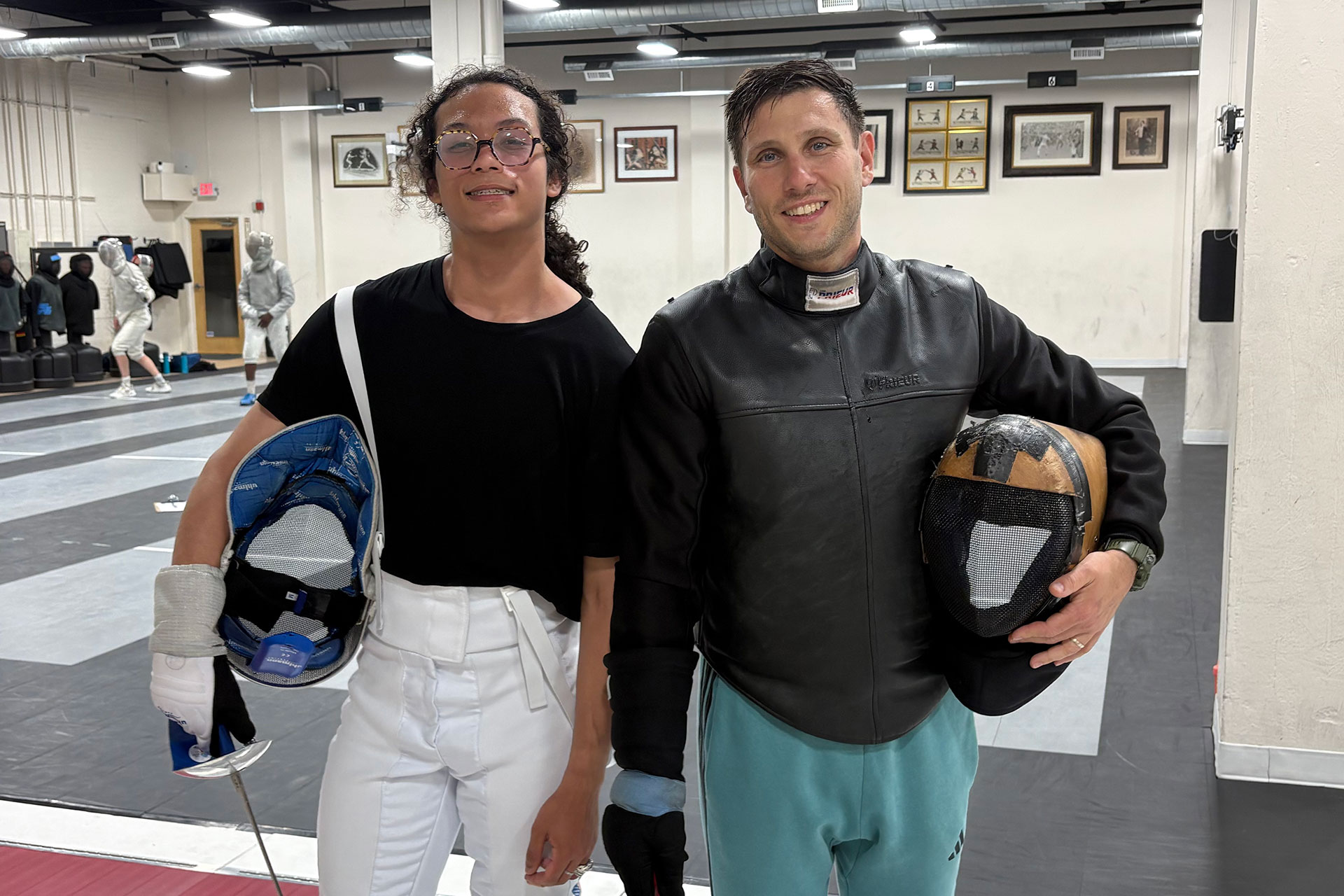
At a glance: After Rio, Phoenix spent six weeks rebuilding his foundation at Pioneer Valley Fencing Academy, including an undefeated Zeta tournament on 3 May 2026. Then came the Senior African Championships in Abidjan, Côte d’Ivoire (June 2026), a move to Zeta’s Elite Class on 8 June, and selection for the Senior World Championships. The post ends with what he is looking for in a college fencing program.
After the April 2026 Cadet and Junior World Championships in Rio de Janeiro, I came home humbled.
Rio was one of the most difficult experiences of my athletic career. It forced me to confront hard truths about my fencing and about myself. If I was going to become the fencer I dream of being, meet the expectations of my federation, and reach the goals I had set, something significant had to change. I wrote about that experience here: I Cried on the Strip in Rio and It Changed My Fencing Forever.
What Rio taught me, more than anything, is that competing at this level demands a truly solid foundation, and that mine still had gaps to close, particularly in the rules and in my footwork. The fencers who beat me were further along that road, and I decided that if I could not yet match their results, I could at least match their commitment to getting better.
I am aware of how unlikely my position is. I turned sixteen this past April, and I only began fencing in November 2024. In less than two years I have gone from picking up a sabre for the first time to representing Nigeria on the cadet, junior, and senior international circuits, with a potential senior FIE world ranking alongside junior and cadet rankings. Those rankings are a starting point, not a destination, and my job now is to climb them. My path is ambitious, and I am profoundly grateful for every opportunity that has been placed in my way to make it possible.
Finding PVFA
My start in the sport came at Enfield Fencing Club, where I trained under coaches Madison Fournier, my main coach, and Gherardo Mauri; Ben Ide, who gave me my very first fencing lesson; the dynamic fencer and coach Tim McCaffrey; and the intense and accomplished Ian Tucker. They took me by the hands and set me on this path, and I would not be where I am without that beginning.
Following Rio, where Coach Madison Fournier was pivotal to my even getting there, I felt that I needed some more foundational elements to my training, and after researching I concluded that Pioneer Valley Fencing Academy (PVFA) and Fencing Master Paul Sise would be that next step.
Ironically, I had been there before. In 2025, shortly after I first started fencing, I visited PVFA. At the time, the distance from my home, and the even greater distance from my school, made regular training impossible. One year later, with much higher stakes and a clearer understanding of what I needed as an athlete, that distance no longer seemed insurmountable. The depth of coaching and talent at PVFA made it the best fit for what I was looking for at that stage.
My family and I reached out to Fencing Master Sise. My mom made the call. Fencing Master Sise answered and, without hesitation, said he could help. Even more surprising, he remembered me.
His mission was straightforward but ambitious: prepare me for the Senior African Championships in Abidjan, Côte d’Ivoire, in the first week of June 2026. Time was not on our side. We had roughly six weeks.
Fencing Master Sise also agreed to host my Loomis Chaffee Independent Study Program (ISP) in fencing this past spring. The ISP allows students to integrate high-level athletic pursuits into their academic curriculum and requires a supervising coach to submit regular reports to the school. It was a chance to bring my education and my athletic development into genuine alignment, two pursuits I take equally seriously.
Building the Next Layer
Our first meeting was not a lesson. It was a strategy session.
Fencing Master Sise assembled a small team to address my weaknesses and accelerate my development, with Coach Zeno Doeleman as my tactical coach and Coach Aurora Colter on footwork, technique, and open bouts. Despite their accomplishments, they immediately made me feel welcome and got to work.
Very quickly, I came to see how much room I still had to grow. There were situations I had been reading the wrong way, rules I needed to know more thoroughly, and habits to refine: I was surrendering priority too easily, and my defensive game had room to develop. These were the natural next layers for a fencer at my stage, the things you can only build once the basics are in place, and now was the time to build them.
That foundation needed tweaking.
Back to Basics
Fencing Master Sise and his team designed a program specifically for me, and the first thing they did was take me back to basics. For some athletes, that might feel like a step backward. For me, it became one of the most important moments in my fencing journey. I embraced it.
The pace was demanding and often exhausting, but something unexpected happened: I began enjoying fencing again. The joy that had gone missing after Rio slowly returned.
Equally important was the environment. PVFA is more than a club; it is a community. The members welcomed me immediately, and before long I felt like part of a fencing family. Fencing Master Sise has built a culture centered on inclusion, kindness, and mutual support.
To test our progress, I entered a Zeta tournament on May 3, 2026. I went undefeated. The result was a tremendous confidence boost and a validation of both the training and our direction. At the same time, I understood that the level of competition was considerably different from what I would face on the international FIE circuit. The real test was still ahead.
Abidjan
For the African Senior Championships in Abidjan, Coach Zeno accompanied me. My results were disappointing, but I do not feel like I failed. That distinction matters to me, and it matters for my growth. I know I did not perform the way I should have. Even so, I refuse to call it a failure. The responsibility for how I fenced that day is mine, and that is exactly where I want it to sit, because it is the part I can do something about.
Abidjan was hot, the kind of heat that becomes its own opponent. Some fencers handled it better than others. I did not handle it well. I also made a costly rookie mistake: I did not pack my fencing shoes, and there were no equipment vendors at the event. The closest thing I could find was a pair of tennis shoes, which I broke in on the fly. They were not the reason I fenced poorly, but they certainly did not help.
That mistake, though, came with a silver lining. Being forced onto the wrong shoes made me reevaluate what I had been wearing in the first place. When I got home, I did a deep dive into fencing footwear and switched to a pair that offers better support and suits the way I fence. A frustrating oversight ended up improving a part of my setup I had never thought to question.
Moments before my bouts began, I spotted one of the fencers who had dominated me in Rio, and then my pool changed at the last second. Some absences forced a reconfiguration, and the new pool dropped two Olympians into it just as we were about to begin. Seeing that familiar face, and that level of competition, rattled me more than I anticipated, and mentally I never fully recovered. The scoreboard reflected a poor performance.
What I saw off the strip, though, reframed the whole trip for me. Some of my Nigerian teammates arrived with broken equipment. Four épée weapons failed weapons check and had to be repaired. Coach Zeno and the Nigerian Fencing Federation head coach, Coach Alogba Ibrahim, worked late into the night trying to get them functioning well enough to pass. Coach Ibrahim stayed back two hours longer still, and with the help of the local weapons-check officials, got the equipment to qualify. Watching that showed me how much goes into simply making it to the strip, and what some of my teammates were quietly carrying.
And the team delivered. The Nigerian épée squad performed exceptionally well, and my two sabre teammates went even deeper than the épée team. For the first time, Nigeria fielded a team to compete in Men’s épée. Being part of that, even on a hard personal day, is something I will carry with me.
That evening, the federation held a dinner at 6:30 on June 2nd, after my competition had ended. I was feeling lousy, and it would have been easy to stay away. But I felt strongly that I should show up. I went to congratulate my teammates and to thank Coach Ibrahim and Coach Zeno. A bad day on the strip is no excuse to be absent for the people who earned a good one.
But the scoreboard did not tell the whole story. I am a better fencer today than I was in Rio de Janeiro. Even though the results in Abidjan failed to show it, my form, understanding, discipline, and technical execution had all improved significantly.
The Next Step: Putting in the Work at Zeta
Abidjan made one thing unmistakable: I have to put in the work, and there is no shortcut for it. Part of it is the mental side, the composure under pressure that I most need to close. But it is not only mental. The other part is repetition, the slow accumulation of muscle memory that turns a move I understand into a move my body makes without thinking. You cannot reason your way to that under pressure. You have to drill it until it is automatic.
The most direct way to build both is more high-level bouting against fencers who push me every single night. After Abidjan, PVFA felt that I needed a more specialized kind of training, the next step beyond what they had built in me. That was when I chose to reach out to Zeta, and as of Monday, June 8th, I have joined its Elite Class.
Zeta is not new to me, either. I had attended several of Zeta’s elite camps before this point, so I already knew the room, the intensity, and the level of fencer it draws, and that familiarity made the move feel less like a leap and more like a natural next step. For a long time, distance was what kept me from Zeta. It sits even farther from home than PVFA, and that alone had made it feel out of reach. My parents committed to making the long drive.
Zeta’s Elite Class is designed for exactly the kind of training I now need. It is where national and international competitors train, and admission depends on a fencer’s level, athletic potential, and commitment to the sport, with enrollment subject to the Head Coach’s approval. Fencers in the program train five days a week and follow an extensive national and international tournament schedule. The structure is demanding by design: group classes four evenings a week and one evening focused on open bouting. The program includes dedicated advanced footwork and bladework, an understanding of how to take care of the body, and refined technique, with two to three private lessons each week on top of regular class and competition attendance. That volume of high-level bouting and supervised electric sabre is precisely the environment I have been chasing.
During the elite classes, all four coaches are active in helping fencers train, but my primary contacts are with Eli, Coach Barni, and Coach Irem, all of whom have been very generous with their knowledge. Eli Dershwitz, Zeta’s owner and president, is a 2023 World Champion and a three-time U.S. Olympian, and one of only two American men ever to win an individual senior world title. He began fencing at Zeta himself as a child and went on to win national titles and individual NCAA championships at Harvard, so he understands the path I am on from the inside. Barnabas “Barni” Csanyi, Maître de Sabre and Zeta’s Head Coach, is my primary coach; he trained in Hungary under legendary coach Istvan Decsi and has produced medalists at the national, European, Asian, and World Championship levels across three continents. Ipek Irem Ülkü, also a Maître de Sabre and Zeta’s first female Master Coach, was the first Turkish woman to medal internationally for her country, has coached national-team fencers and European champions, and brings nearly two decades of coaching along with a deep background in fencing biomechanics and performance research. Working closely with coaches of that caliber, night after night, is a large part of what makes this the right room for me right now.
Off the strip, Zeta is quarterbacked by Annette Pein, Ph.D., an accomplished saber fencer in her own right. As Executive Director, she oversees every aspect of the club’s administration, programming, and communications, and she takes the time to educate parents and fencers about USA Fencing regulations, tournament types, points lists, and the qualification paths to national championships. She always has a warm smile, a kind word, and a way of uplifting fencers and their families. In a sport where the rules and pathways can be bewildering, that guidance is its own form of coaching.
There is one more thing that sets Zeta apart: all it does is saber. Period. There is no splitting of attention across three weapons, no diluting of focus. Every coach, every drill, every bout in that room is built around the one weapon I fence, and you feel that singularity of purpose the moment you walk in.
That preparation will carry directly into the lead-up to Hong Kong. Ahead of the championships, I will travel to Shanghai for a pre-World Championships training camp with Coach Eli and Coach Barni, a chance to sharpen my game against new opposition in a focused, high-intensity environment.
Coach Barni and the Long Game
When Coach Barni approved me for the Elite Class, he had already seen the thing I most needed to fix: under pressure, I freeze. He understood the problem clearly, and rather than reach for a quick patch, he built a program meant to unfold over the long haul, one designed to mold me into a fencer whose motor skills hold up and fire automatically in the most stressful moments of a bout. That is exactly what I came to Zeta for. As I put it when I made the move, I wanted the chance to deploy my fundamentals consistently against higher level fencers who want to eat my lunch.
What I value most in his coaching is its precision. His footwork and bladework are built so that the right action happens by design, not by luck. Nothing is left to chance or to a hopeful lunge; every movement has a purpose, and the goal is to make the correct response so ingrained that I no longer have to think my way to it under pressure. That is a slower road than chasing quick results, and it is the right one.
The fencer he is shaping me into is a deliberate, structured sabreur: someone who controls distance, sets up actions rather than gambling on them, and wins through preparation and clean tempo rather than raw athleticism alone. I am young in the sport, which means much of my game is still being built, but that is also the opportunity. I am not a finished product defending old habits; I am a fencer being constructed correctly from the ground up, and I am hungry to keep building.
Choosing the Harder Path
I was selected by Nigeria to represent the country at the 2026 Senior World Championships in Hong Kong, and invited to compete at the Commonwealth Championships in Lagos, Nigeria, later this summer.
I have decided to accept Hong Kong and to decline Lagos.
Let me be honest about Hong Kong: my goal there is a modest one. At the senior world level today, getting out of my pool would be a tall order, and I am not going to pretend otherwise. For me, success in Hong Kong looks less like a result on the board and more like competing with composure, winning touches against world-class sabreurs, and measuring how far I have come. For a while that daunting challenge made me want to stay home. Then I asked myself a harder question. Should fear of the scoreboard keep me from going to see how far I have actually come? I do not think it should. The fencer who let the moment shrink him in Abidjan is exactly the fencer I am trying to leave behind, and I will not become someone new by hiding from the hardest rooms in the sport. Hong Kong is the best measuring stick there is. Win or lose, I will learn more about my progress in three minutes against a world-class sabreur than in a month of comfortable bouts, and I will come home knowing exactly what still needs work.
Lagos is the other side of the same judgment. There is a real temptation, especially for a young athlete, to accept every invitation that comes. But spreading myself thin across the calendar would teach me little. I would rather choose my battles deliberately.
There is a practical thread running through all of this, as well. I have now traveled with coaches, and I have come to understand where that dedicated coaching truly pays off: in the rounds after pools, when a coach between bouts can change the outcome. I have not yet earned that. To revisit traveling with a coach, I need to consistently make it out of my pools first, and until I do, the smarter investment is the preparation I put in before I ever get on a plane. I am well aware that I hit the jackpot in the parents department. They have supported me through thick and thin, with their only admonition being that “if you want to be a bum, be the best possible bum you can be.” Earning the privilege of competing at this level starts with the work.
The larger target is next year’s Cadet and Junior World Championships in Tallinn, Estonia. That is the right stage for where I am in my development, and everything this year is aimed at arriving there prepared rather than merely present.
My path has been an unusual one. I was plucked to represent a country before I was quite ready, given the honor of the strip before I had fully grown into it. I do not take that lightly. It is now my job to become the fencer that selection assumed I already was, and to repay the faith placed in me by earning every result that follows.
The Road Ahead
The road ahead is built around that work. Beyond Zeta, Shanghai, and Hong Kong, I will sharpen myself in smaller regional, national, and international tournaments that make strategic sense. I got my first real taste of the new approach close to home at the NEUSFA Pomme de Terre tournament in Waltham, Massachusetts on June 13th. It was, in many ways, an affirmation that Coach Barni had read me correctly. The pressure moments he had flagged from the start are still a work in progress, so the program he laid out is clearly the right one and it is far from finished. But alongside that, I fenced with a clarity and composure I had not had before. I was more deliberate, more in control of my actions under pressure, and it showed. In a deep senior field of A- and B-rated fencers, as a cadet and junior, I won the kind of bout that should simply become routine and normal for me, and it felt earned rather than lucky. The fencing is moving in the right direction. The results will follow.
The summer holds two more projects that matter deeply to me. Alongside my training, I hope to finish designing and building my first publicly playable game. The second is my first solo book, which I hope to publish before the season is out. I have written before, but always with a collaborator: my twin sister and I co-authored Twins’ Walkie-Talkie Chronicles and So You’ve Got a Crush… Now What?: A Teen’s Survival Guide to Navigating Your First Crush. This will be the first book I carry start to finish on my own. Fencing, game design, and writing may seem unrelated, but they ask the same things of me: discipline, patience, and the willingness to keep refining something long after it would be easier to stop.
I have received, and continue to receive, excellent coaching and training. The responsibility remains mine to translate it into results. My goal is not simply to attend a World Championship; it is to arrive prepared to compete. Everything I do between now and Tallinn will be directed toward that.
My ambitions run further still. I want to represent Nigeria at the Olympic Games, and I want to do it as a fencer who has earned every step of the way there. I am equally serious about my education. I am a strong student at Loomis Chaffee, an academically demanding and well-regarded school, and I have earned departmental approval to take college-level courses beginning in my junior year. I hold the classroom and the strip to the same standard. It is worth noting that Loomis does not have a fencing program of its own, yet it has been incredibly supportive of my fencing. This past spring, the school approved an Independent Study Program that allowed my club to integrate fencing into my schedule, a level of trust and self-direction I do not take for granted. That kind of support has made everything else possible.
When college time comes, I would love to be part of a fencing program of my own. Nearly all of my teammates have that, and I want the experience of training and competing alongside a team day in and day out. What I am looking for is specific: a program where I can develop under a college coaching staff over four years while continuing to pursue an international track, at a school that is genuinely strong in both fencing and academics. I am looking for a four-year home and a place to grow, not a flag of convenience. I am early in exploring what is out there and in no hurry to narrow it down, because what matters most to me is the right fit, a place that takes the strip and the classroom with the same seriousness I do.
The journey continues. And for the first time since Rio, I am excited about where it is leading.
← Previous: I Cried on the Strip in Rio | Next: One Touch Beyond the Goal →
