
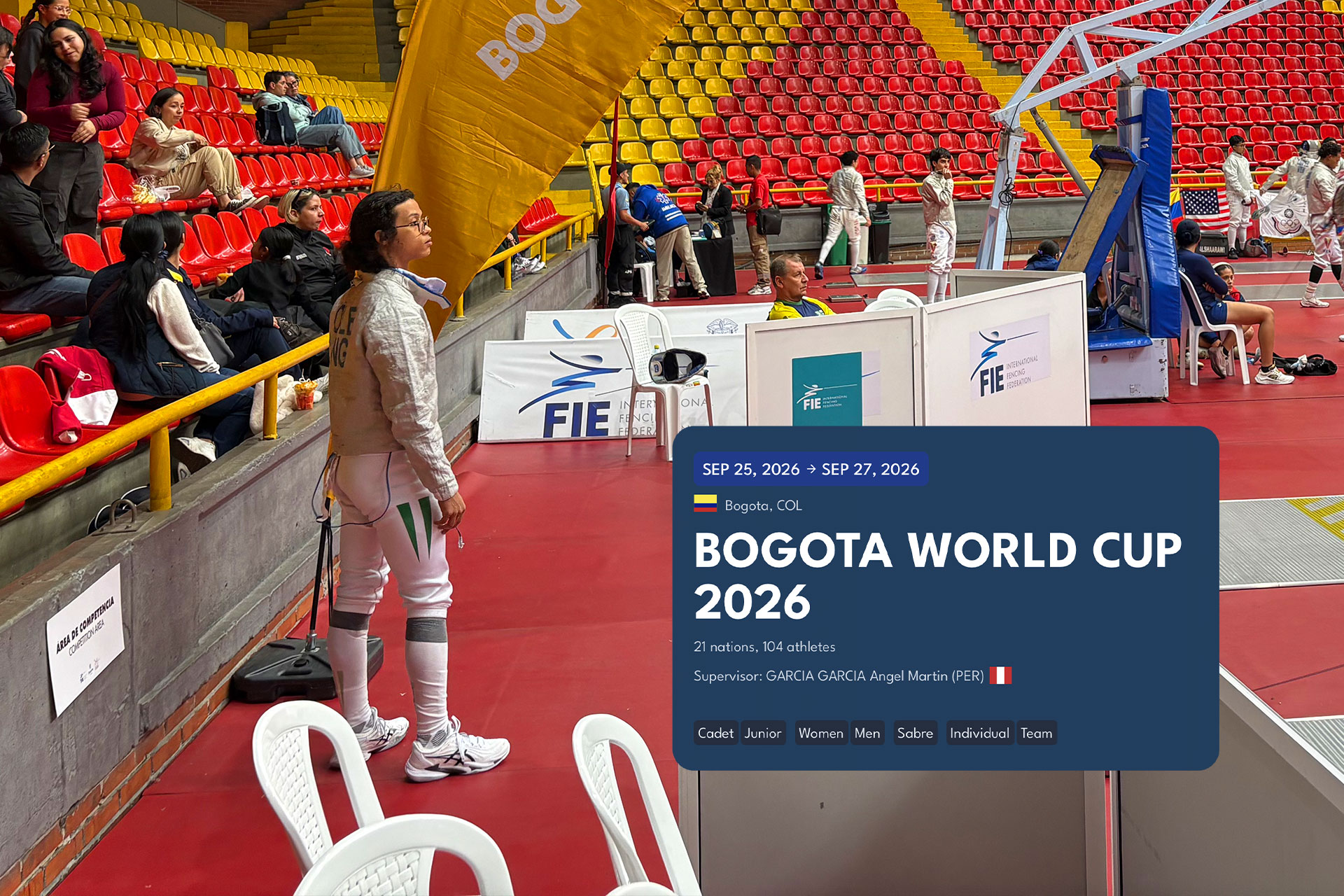
At a glance: Junior and Cadet World Cup, Bogotá, Colombia, 25 and 26 September 2026. Phoenix reached the direct-elimination rounds in both the cadet and junior events and earned six FIE points. His cadet world ranking rose from 151 to 61 and his junior ranking from 467 to 260, and USA Fencing awarded him a B2026 rating.
My flight was leaving in ninety minutes. My next bout was starting in eighty-five.
Until that moment, I had never needed to plan for getting this far in an international competition. Now, in Bogotá, Colombia, I had qualified for the junior direct elimination round, and the itinerary my mom and I had made no longer fit the fencer I was becoming.
I was exhausted. I was homesick. Part of me wanted to leave.
I called my twin sister and my best friends, Pierce and Owen. They urged me to stay and fence. Friends and teachers joined the excitement. Finally, I told my mom I wanted to stay. She headed to the airport to change our flights, and I stayed at the arena to prepare.
For someone who had grown accustomed to dealing with not making it past the pool rounds, this was truly unfamiliar territory. And I had no roadmap for navigating this new paradigm.
Before the breakthrough
Writing has always helped me understand my losses. It is cathartic. It channels my disappointment and helps me find the silver lining in the experience. After Bogotá, though, I sat down with an entirely different problem.
In two days, I earned six FIE points: four in cadet and two in junior. In the rankings released on September 29, 2026, my cadet world ranking rose from 151 to 61, and my junior ranking rose from 467 to 260. I was also ranked 540 in senior men’s saber. USA Fencing awarded me a B2026 rating based on my junior results.
I was thrilled, but since then, I’ve struggled to write about it all. Like, how am I supposed to write about this now? I knew how to examine and analyze what had gone wrong. How was I supposed to explain what had finally come together?
The numbers might suggest an overnight breakthrough. My memory goes back to my first ever fencing lesson on November 22, 2024, at 7:00 p.m. It was for foil.
I was home on break from the Loomis Chaffee School and had recently earned my yellow belt in jiu-jitsu. I had wanted to try fencing but didn’t have immediate access to it. And so it was that three days later, a group lesson introduced me to saber. I was in love. No offense to foil, but I wanted the slashy one, not the pointy-pokey one.
My school did not offer fencing. I decided to pursue it anyway. In February 2025, I became a member of the Nigerian team and began representing Nigeria internationally.
That opportunity did not make me instantly confident. I struggled with the sport, with my nerves, and with hearing that international fencing might not be for me. Some people suggested lowering my goals. I was told that to make it in saber, I needed to have started by age eight. I had no way of turning back time, so it was either give up or keep at it. I kept working and grinding away, even when I could not yet point to results that justified my ambition. I had my doubts, of course.
A goal I could work toward
An important change came when in June 2026, Dr. Annette Pein, Zeta’s Executive Director, selected Coach Barnabas “Barni” Csanyi to work with me. My mom and I asked why she thought he was the right coach. Then he joined us and explained what he saw in my fencing and how he envisioned my development. I had attended a few elite camps at Zeta and won my first tournament there. So, Zeta was a known quantity by the time I applied to join Zeta in June 2026.
Listening to Coach Barni felt like listening to an oracle. He could see possibilities I was still struggling to recognize. He made it clear that if I was ready to get to work, nothing was impossible. That’s Coach Barni for you. And by the way, Dr. Annette has never been wrong about any pairing she’s made at Zeta.
Coach Barni asks me to establish an objective for each tournament. For the World Championships in Hong Kong, I hoped to score a touch against each pool opponent. Realistically, I knew I would be thrilled with five touches. I scored six. For the 2026 Coupe de Monde, Bogotá, Columbia on September 25 and 26, the cadet goal was to advance out of pools. In junior, against older and tougher competitors, the goal was to be as competitive as possible.
Those objectives gave me something specific to prepare for. Back at boarding school and without a school fencing program, I had limited access to practice, so we worked on what I could accomplish outside the club. Then, out of the blue, like the heavens opening up, Zeta’s president and owner, multiple world champion Coach Eli Dershwitz, opened two Sunday camps that became critical opportunities. Coach Barni changed his schedule to attend and help me prepare. Coach Eli, who has won at just about every elevation and in every condition, gave me solid tips for dealing with the altitude sickness that might crop up in Bogotá, roughly 8,600 feet above sea level.
I was learning that commitment includes making careful use of the time and resources you actually have. Some days, progress meant a lesson at Zeta. Other days, it meant following the routines that Coach Barni had given me while managing my challenging schoolwork.
First, find the arena
My mom and I reached our Bogotá hotel at about 1:00 a.m. on the morning of the cadet competition. After roughly five hours of sleep, we left for the venue and arrived at the wrong one.
The supposed opponents around us looked suspiciously like beefy twenty-somethings. They turned out to be the national soccer team players.
People nearby recognized that we were lost and began helping. They made calls, found the correct location, and entered it into our Uber App. We reached the fencing venue at 8:10 a.m., expecting a 9:00 a.m. start. At accreditation, we learned that the organizers had provided the wrong venue information and had therefore delayed the start until 10:00 a.m.
Relief.
The altitude added another challenge to an already demanding morning. We had prepared with attention to hydration, food, recovery, and conserving energy. Once the immediate rush was over, I used music and a podcast to settle myself before returning to warm up.
My cadet pool began with a bout in which I scored only one touch. I scored three in the next, then won the following two. Qualification was within reach, and my nerves returned.
During one of the later bouts, I scored a defensive touch that surprised me enough to make me laugh. The referee interpreted it as laughing at my opponent and gave me a yellow card. Wow! Okay! I lost focus and then lost the bout.
It was a small moment with a clear lesson: even my reaction to an expectedly good touch needed discipline.
Still, I advanced to direct elimination.
My mom sent videos to Coach Barni, who, along with Coach Eli, was coaching at another competition in New York. He analyzed my fencing remotely and sent adjustments. He reminded me that I had accomplished my objective and encouraged me to relax, trust my training, and have fun.
I lost my elimination bout, 11-15. But I had already achieved my objective for Bogotá.
Back at the hotel, I ate, napped, and did homework. International competition had not canceled my responsibilities as a student. As I have to remind myself, “student” comes first in “student-athlete.”
An unexpected encounter and highlight
One of the absolute highlights of the trip to Bogotá, Colombia, was an unexpected and incredibly affirming encounter with Flora Palu, an elite national youth development coach for the prestigious French Fencing Federation.
Earlier that day, after cadet pools, my mom and I were waiting for the cadet direct elimination pairings to be posted when she came over and sat next to my mom. She asked if we knew Brou. That’s my Nigerian teammate, Inkosi Brou, ranked No. 13 in the junior world rankings. She knows Inkosi and asked if I was French. Nope, not me.
She said she’d been watching my matches. For real!!! She came to Bogotá with two fencers, one older than me and one younger, she told me. She told me I had strong legs and advised me to work on my hands. She was so generous with her knowledge, and I was so blown away that someone of that caliber saw something in me that made her want to approach my mom and me. When we shared that I had only started saber on November 25, 2024, she was visibly shocked by my rapid progression to the international circuit in under two years. She told me that I was brave and that saber favors the brave. Wow!
For a world-class international coach to introduce herself like that was a testament to the training Zeta and Coach Barni have given me.
Permission to compete
The next morning, I was tired and homesick. I had not built the muscle memory for advancing as far as I had the day before and my legs were feeling it. Junior competition meant a much larger field and older and stronger opponents. I worried about embarrassing myself, my mom, or my coach. That kind of worry sucks up oxygen, and not ideal when already dealing with the altitude.
Coach Barni gave me final instructions and encouraged me to have fun. He told me that I’d already achieved my objective for the trip. There was no pressure. Have fun, he repeated. Nigeria’s head coach, Ibrahim Alogba, who was also analyzing my bouts, was pleased with my cadet performance and urged me to use the junior event as target practice. He told me that I had done my country proud and to go out there and have fun.
That helped. I could concentrate on trying the things I had trained to do.
I lost my opening bout to Brazil’s Marcus Pinto, 1-5, and the next bout also went poorly. My mom encouraged me to develop amnesia about those results, especially since I had my chances in the bouts I lost. I did. I won the next two bouts. Let me repeat, I won the next two pool bouts in junior saber at the World Cup! Then, I began to feel myself fencing more freely.
Two solid wins in my junior pool, with a healthy differential between touches scored and received, meant I was most likely advancing to direct elimination. I was feeling myself fly. I was lowkey also in jeopardy of a third bout win and a possible bye! Can you even envision that? Like what on earth! Um… I had not planned for that. Then my attention drifted toward going home. I lost focus in the remaining bouts. Even so, I qualified for direct elimination again.
Coach Barni was pleased. He told me he was very proud of me. Coach Ibrahim was delighted. I could hardly believe it.
Which brought me to the flight leaving in ninety minutes.
Staying for the next bout
As I said, I had not planned to advance this far, and mom had to get to the airport to see if she could change our flight. After my mom left for the airport, I began worrying about how long she had been gone. We were in Colombia, after all. Eventually, Mom texted: she was okay, and the flights were changed. She returned to the arena about seven minutes before my bout. All that worrying had drained my already limited energy at 8,600 feet.
I went out and fought with what I had left. My legs were heavy. I whiffed my long attack. That’s my favorite new thing, and it had worked well for me in pools. I missed opportunities I could recognize but could not quite finish. I lost, 10-15. It is nevertheless comforting to know that to a great extent there were things within my control that I could have executed better.
I will study those missed touches. I will work on maintaining focus when I am tired, recovering between bouts, and staying present when part of me is already thinking about home. Earning points does not make those weaknesses disappear. It gives me more reason to address them.
It also gives me reasons to celebrate. Yes, celebrate! Imagine that!
I am grateful to Coach Barni for seeing a path forward and helping me follow it; to Coach Eli for giving me survival advice and for the two back-to-back Sunday camps; and to Coach Ibrahim for his ever-present support. I am grateful to my club Zeta and Dr. Annette. I am grateful to my mom for navigating everything from a misplaced venue to a last-minute flight change; to my dad for championing me from afar; and to my sister, Owen and Pierce, friends, my teachers and school for encouraging me from far away to stay and fight on. I am grateful, too, to the people in Bogotá who stopped to help two strangers find an arena.
And I am proud of myself. That is a sentence I am learning to write as honestly as I write about my disappointments.
I left Bogotá with a massive haul of six FIE points, two direct elimination appearances, and plenty of work ahead. When I next pack for an international competition, I will remember to leave room in the itinerary for advancing.
I know now that I might need it.
← Previous: One Touch Beyond the Goal | Latest results: Phoenix’s FIE profile →
