
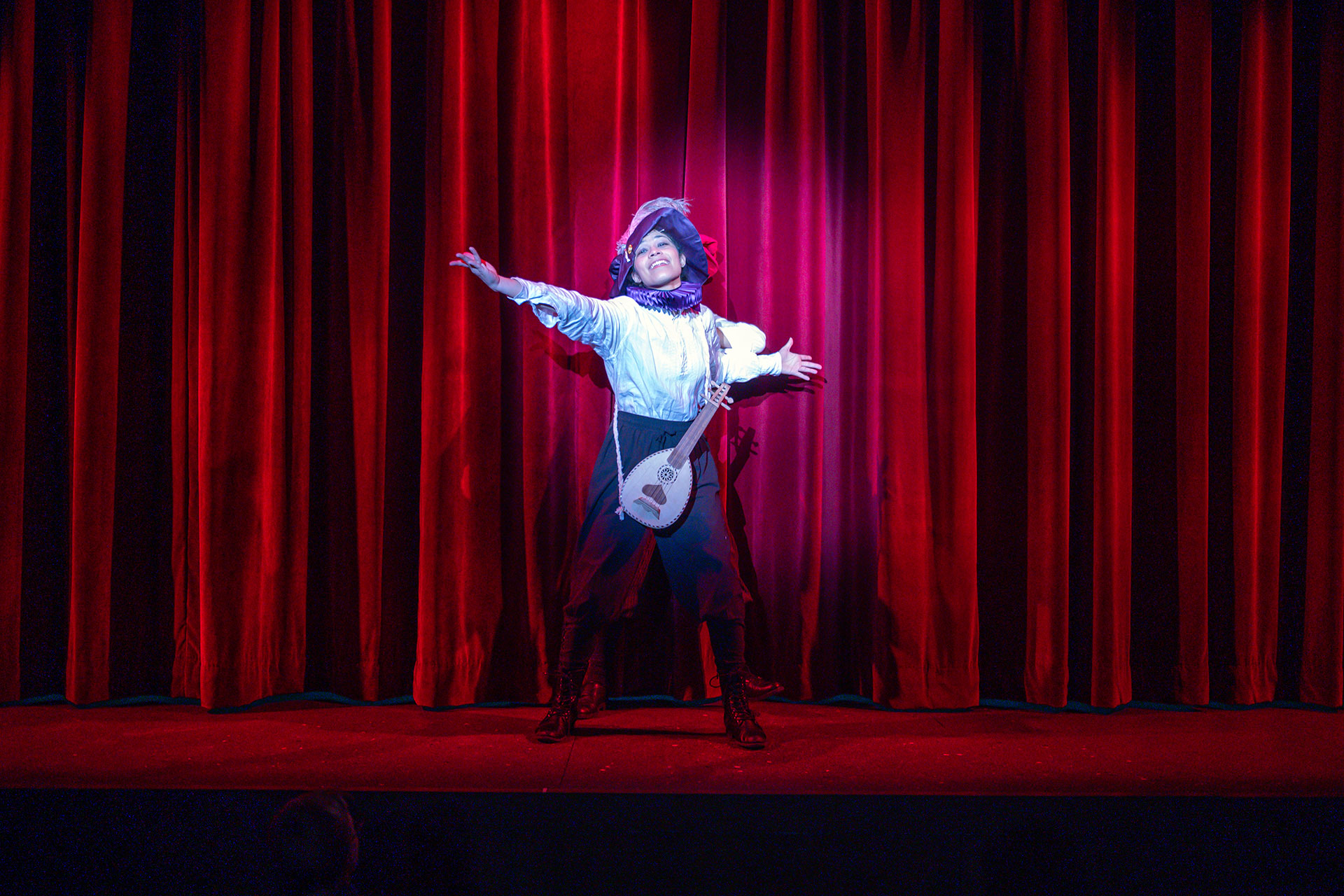
At a glance: Zieozi traces her path through theater, from Wilbur in Charlotte’s Web in fifth grade to Jester in Melanie Guerin’s original musical The Burrow at Loomis Chaffee. Along the way she won an individual acting award from the Massachusetts Educational Theater Guild.
People sometimes ask me when I decided I wanted to be an actor.
The truth is, I don’t think there was one defining moment. It happened one role at a time.
At sixteen, I don’t have my story figured out, and I hope I never stop growing. Every rehearsal, every performance, every director’s note, every success, and every mistake has taught me something I couldn’t have learned any other way. Looking back, I can trace my journey through the characters I’ve played, not because I’ve arrived, but because every role has carried me a little farther forward. I’m still becoming.
Whether I’m writing a novel or stepping onto a stage, I find myself asking the same question: Who is this person, and what do they want? That question has guided every character I’ve written and every role I’ve played.
Alongside my twin brother, Phoenix Zaoku Olen, I co-authored So You’ve Got a Crush… Now What?: A Teen’s Survival Guide to Navigating Your First Crush and Twins’ Walkie-Talkie Chronicles. Writing those books taught me that believable characters aren’t created through dialogue alone. They’re shaped by motivation, relationships, flaws, and growth. I love the ability to shape characters through telling their stories in my own way. Collaborating with my brother also taught me how to listen, revise, compromise, and trust another person’s ideas while still finding my own voice. I’m now finishing my first solo novel, and every chapter reminds me how deeply writing and acting influence one another. I have discovered that I have a strong interest in understanding human behavior whether through writing or acting or everyday interactions. The more I write, the better I act. The more I act, the better I write.
My theater journey has unfolded the same way, one character at a time.
In fifth grade, I played Wilbur in Charlotte’s Web. I loved every second of being on stage, but it wasn’t until sixth grade, when I played Miss Honey in Matilda, that something clicked. Somewhere between rehearsals and curtain call, I realized I didn’t just enjoy theater. I wanted it to be part of my life forever.
By eighth grade, theater had become more than an extracurricular. It had become part of who I was.
Playing Winifred Banks in Mary Poppins introduced me to the emotional power of musicals. Through her, I discovered that songs could reveal feelings that dialogue alone sometimes couldn’t. I didn’t just enjoy musicals after that production. I fell in love with them.
Later that year, I was cast as Tabaqui in The Jungle Book, while my twin brother played Tabakoo. During auditions, our director said we had great chemistry together. I guess growing up together finally paid off. We really played off of each other. Before that show, I never thought of myself as funny. Tabaqui proved me wrong. Discovering that I could make an audience laugh was one of the biggest surprises of my young acting career. Perhaps, the most rewarding part of these roles was that my brother and I both received individual acting awards from the Massachusetts Educational Theater Guild for our performances. That recognition meant a great deal, but even more meaningful was discovering that taking risks often reveals abilities you never knew you had.
When I arrived at Loomis Chaffee as a freshman, I was excited and intimidated all at once.
Being cast as Isabella in Measure for Measure introduced me to Black Box theater. Shakespeare in such an intimate space demanded honesty, vulnerability, and complete focus. I honestly couldn’t believe I had been trusted with such a significant role as a freshman, and it challenged me in ways I hadn’t expected. I left every rehearsal emotionally exhausted in the best possible way.
Then came Something Rotten.
When I saw the cast list, I found my name next to “Minstrel 1.”
That was it.
I went home, cried for two days, and convinced myself the directors had made a mistake. I had auditioned for much larger roles and couldn’t understand why I hadn’t gotten one.
My parents listened to me vent before reminding me that I was one of only four freshmen cast in the production. Then they asked me a question I still think about today.
“Can you become the best Minstrel 1 anyone has ever seen?”
That changed everything.
Instead of wishing for another role, I decided to fully embrace the one I had. I lowered my voice, changed my walk, figured out how to move like my character, practiced a coin-flip sleight-of-hand trick for my entrance, and even started looking forward to the choreography. The jumping sequences, especially those incorporating arabesques, became some of my favorite moments in the show. By closing night, I wasn’t thinking about the roles I didn’t get anymore. I was having too much fun playing the one I did.
That production taught me something I carry into every audition now. There are no small roles. There are only opportunities to tell a story well.
Sophomore year brought even bigger challenges.
As Helena in A Midsummer Night’s Dream, I experienced one of those moments every actor dreads. During a performance for the entire school, I missed the timing on Helena’s slap. There was no sound. Lysander reacted too late. I reacted too late. The whole moment fell flat.
I was mortified.
For days, I replayed that scene in my head. I had been looking forward to that performance because I wanted my classmates to see what I could do. Instead, all I could think about was one missed moment.
Eventually, I realized audiences remember entire performances, not isolated mistakes. Learning to let go of imperfections may be one of the hardest lessons theater has taught me.
Only a month later, I auditioned for Melanie Guerin’s original musical, The Burrow.
Honestly, Jester was the role I wanted from the beginning. It sat at the heart of the story and demanded acting, dancing, and singing. The audition itself reflected that challenge with separate acting, dance, and vocal callbacks.
During the dance callback, Melanie kept correcting me.
At first I thought, Wow…I must be doing terribly.
Later I realized something completely different.
She wasn’t criticizing me.
She was investing in me because she believed I could grow into the role.
She was right.
Playing Jester pushed me further than any role I had played before. Learning to sing while dancing without running out of breath took weeks of practice. I had to learn that breath isn’t just a vocal technique. It’s part of acting. Every movement affects every note, and every note communicates something about the character’s emotional life. Building the stamina to dance, sing, and stay emotionally present became one of the most rewarding challenges I’ve ever taken on.
During one performance, I forgot the lyrics in the middle of one of my solo songs.
For about two seconds, my brain completely froze.
Then instinct took over.
I stayed in character, improvised, found my place in the song, and kept going. Most people never realized anything had happened, but I walked off stage knowing I had become a stronger performer. Live theater doesn’t ask for perfection. It asks for presence.
Another rehearsal completely changed the character.
I originally imagined Jester with a hunched posture because I thought it made the character quirky and playful. Melanie stopped me almost immediately.
She wanted Jester to stand taller.
At first, I was attached to my idea. Looking back, she was absolutely right. The moment I changed my posture, Jester became more expressive, confident, and emotionally engaging. That rehearsal reminded me that acting isn’t about defending your first instinct. It’s about trusting the rehearsal process enough to discover something better.
One of my favorite parts of The Burrow had nothing to do with my own role. The senior actors welcomed me from day one. They answered questions, shared stories from productions they had done, offered encouragement during difficult rehearsals, and modeled the professionalism that comes with experience. They never made me feel like “just a sophomore.” They treated me like a fellow artist. Watching the way they supported one another taught me as much as any acting exercise. They made me want to become that kind of mentor for younger actors someday.
Getting cast as Jester also came with an unexpected challenge.
For the first time in our lives, my twin brother and I were cast in different productions. He was performing in the Black Box production while I was rehearsing The Burrow.
I won’t pretend that was easy.
Since elementary school, we’d shared every stage, every rehearsal schedule, every cast list, and every opening night. Performing together had become part of how I experienced theater.
Over Thanksgiving break, my parents asked us two simple questions.
“Do you love performing?”
“What is the growth in this situation?”
The first answer came immediately.
Of course I love performing. Theater doesn’t just feel like something I do. It feels like where I’m supposed to be.
The second question stayed with me much longer.
Eventually, I realized that my brother and I can be incredibly close while still growing into different artists. We won’t always be cast together. We may not even attend the same college one day. Learning to celebrate each other’s journeys while pursuing our own has become one of the most important lessons I’ve learned, not just as an actor but as a person.
Working on The Burrow also deepened my appreciation for original theater. Unlike a well-known musical, we weren’t simply recreating something that already existed. We were helping shape a story that was still growing. Every rehearsal invited us to experiment, ask questions, and discover something new alongside the playwright and directors. It reminded me that storytelling is alive. It changes with every rehearsal and every performance.
That spirit of growth has continued beyond the school year.
This summer, I have been studying privately with an accomplished actor, theatermaker, and acting teacher whose work spans stage, television, and film. His approach to character development has challenged me to ask better questions before I ever memorize a line. What does this character want? What are they afraid of? What are they trying not to say? I’ve realized that understanding a character begins long before stepping onstage. Those lessons have already changed how I prepare for every audition and every rehearsal.
They’ve also made me a stronger writer.
As I finish my first solo novel, I find myself approaching my characters the same way I approach a role. Every character has an objective. Every scene has emotional stakes. Every decision matters. Acting and writing are no longer separate passions in my mind. They’re two different ways of telling the same kinds of stories.
If someone asked me which role has been my favorite, I honestly couldn’t answer.
Wilbur gave me confidence.
Miss Honey gave me purpose.
Winifred made me fall in love with musicals.
Tabaqui showed me I could be funny.
Isabella taught me emotional honesty.
Minstrel 1 taught me humility.
Helena taught me resilience.
Jester taught me trust, collaboration, and endurance.
Every role gave me something I didn’t have before.
I’m still becoming a better actor, a better writer, and a better collaborator. I’m still discovering the kinds of stories I want to tell and the kind of artist I hope to become. Every rehearsal, every performance, every critique, every standing ovation, and every mistake has shaped me.
I don’t know what my next role will be, but I know it will teach me something I don’t know yet.
The curtain will rise again.
When it does, I’ll be ready to learn whatever the next role has to teach me.
